It’s one of the first questions we get asked, and a fair one: will a heat pump annoy me, wind up my neighbours, or ruin evenings in the garden? Plenty of sites will tell you “heat pumps are quiet” and leave it there. Here’s the actual number: published figures for the units we install most sit in the mid-40s to low-50s dB(A), below normal conversation, and there’s now a legal limit of 37 dB(A) at your neighbour’s window that any UK installation has to meet. Below, we’ll break down where those figures come from, what they mean in everyday terms, and what genuinely affects the noise you’ll hear day to day, so you can judge for yourself rather than take our word for it. If you want the fuller picture first, our beginner’s guide to air source heat pumps is a good place to start.
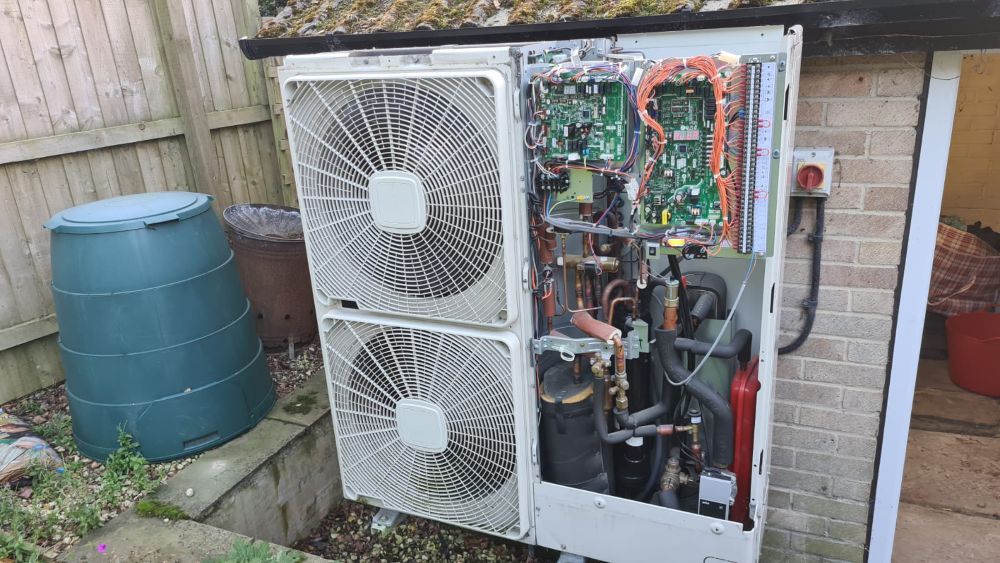
How loud is an air source heat pump, actually?
Heat pump noise is usually quoted as a “sound power level,” written dB(A). It’s a measure of the total sound energy the unit produces, not how loud it sounds standing next to it; the level you’d actually hear drops off quickly with distance. Figures also vary by model, output size and operating mode, so treat any single number as a guide rather than a promise.
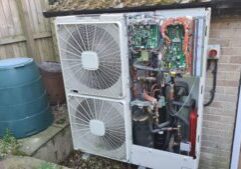
That said, published figures from the two brands we install most give a useful sense of scale. Worcester Bosch quotes its Greensource air-to-water outdoor unit at as low as 53 dB(A), with the air-to-air outdoor unit around 49–50 dB(A). Vaillant’s aroTHERM plus range carries Quiet Mark accreditation, with sound power as low as the mid-40s to low-50s dB(A) depending on model and output, and Vaillant separately measures its quietest setting at just 28 dB(A) from 3 metres away, roughly the level of a ticking watch.
To put those numbers in everyday terms: normal conversation sits around 60 dB(A), a washing machine or dishwasher around 70 dB(A), and a hoover or hairdryer around 80 dB(A). A modern heat pump’s outdoor unit, at somewhere in the 50s, sits below normal conversation and close to steady rainfall or a fridge humming in the kitchen. It’s genuinely one of the quieter things running in most gardens, comparable to a good outdoor air conditioning unit or a quiet extractor fan, not a step up from either.
The one time you’ll hear it working a bit harder is during a defrost cycle, when the unit briefly reverses to clear ice from its outdoor coil. That’s normal operation, not a fault, and it passes within a few minutes.
The rules that actually govern heat pump noise in the UK
Most home heat pump installs in England go in under “permitted development”, meaning no separate planning application is needed, provided the installation passes a noise calculation set out in a standard called MCS 020(a). This is where a lot of the vague online reassurance falls short, because the rule is specific and has recently changed.
Since September 2025, the permitted development noise limit has been 37 dB(A), tightened from the older 42 dB(A) figure that applied for years before that. Crucially, this isn’t measured next to the unit itself; it’s calculated at your neighbour’s nearest habitable room window or door, roughly a metre out. In other words, the rule isn’t really about how loud the unit sounds to you standing in your own garden; it’s about making sure it doesn’t become a nuisance for the people next door.
The calculation takes into account the manufacturer’s published sound power figure, the distance to the boundary, and site factors like nearby walls or fences that can reflect and amplify sound. If a proposed position doesn’t pass, the fix is usually straightforward: move the unit, add a barrier, or choose a quieter model, rather than needing full planning permission, though that route remains available if a site genuinely can’t pass.
A properly MCS-certified installer runs this calculation as standard, before a single pipe goes in, and it’s required for the installation to qualify for the Boiler Upgrade Scheme grant too. It’s a small thing that separates a careful installer from someone quoting off a rough guess; the assessment is meant to protect your neighbours’ peace as much as anything, and it’s not optional.
What actually affects how loud your installation is
The published dB(A) figure is only part of the story. In practice, four things determine how noticeable a heat pump ends up being once it’s fitted, and they’re exactly what a proper home suitability assessment should weigh up before you commit:
Placement matters most. Distance from your own and your neighbours’ bedroom windows makes a real difference, as does proximity to a boundary fence. Hard, reflective surfaces, close brick walls, tight side returns, and glass can bounce sound around and make a unit seem louder than its rating suggests.
Mounting is the next biggest factor. A unit fitted on proper anti-vibration feet, on a stable base away from a shared wall, transmits far less structure-borne noise than one bolted rigidly to brickwork that backs onto a neighbour’s living room.
Age and quality play a part too. Compressor and fan technology has improved a lot in the last decade, so a well-specified modern unit is generally quieter than an older or poorly matched one doing the same job.
And finally, operating mode: as mentioned, defrost cycles are the loudest moments in normal running. If your unit briefly sounds different on a frosty morning, that’s it working as intended.
Practical tips to minimise noise
A handful of sensible choices at the planning stage go a long way:
Site the unit away from your own and your neighbours’ bedroom windows where the layout allows it, and keep it clear of tight corners between walls and fences. Where positioning options are genuinely limited, a small terraced garden, say, an acoustic barrier or fence panel between the unit and the boundary can bring the calculated level down meaningfully. Always insist on anti-vibration mounts rather than a rigid fixing, and if noise is a particular concern, a compact plot, close neighbours, or a bedroom right above where the unit would sit, it’s worth specifying one of the quieter-rated models from the outset rather than the standard option and hoping for the best.
Frequently asked questions
The bottom line
Modern air source heat pumps are, in most cases, one of the quieter pieces of equipment in a garden, not the rattling, humming box some people picture. The regulations exist precisely to keep it that way for your neighbours too. If you’re weighing up a heat pump for a Leeds home and noise is on your mind, a proper site survey, including the noise calculation, is part of how we assess every installation, so you know exactly where you stand before any work begins. Get in touch, and we’ll talk it through.
Remember: Always confirm Gas Safe registration with any engineer. See Energy Safe Register for more info.
GET IN TOUCH on 0113 513 5130 or 07791 586 147
Safe Boiler Installations in Leeds from S Fearn Plumbing & Heating.
Give us a call
Explore your options and start benefiting from a modern, energy-efficient boiler today.