British summers aren’t what they used to be. A few years ago, air conditioning at home felt like something you only came across on holiday. Now, after a run of proper heatwaves, more of us around Leeds are wondering how to keep the house cool without melting into the sofa. The confusing bit is that there are two very different ways to get there: a standalone air conditioning unit, or an air source heat pump that heats your home in winter and cools it in summer. People often assume they’re the same thing; they’re not, quite. Here’s a plain-English look at how they compare, and which one makes sense for a Yorkshire home.
What’s the difference between an air conditioner and an air source heat pump?
At the risk of stating the obvious, an air conditioner cools. That’s its main job. It pulls warm air out of a room, passes it over a cold coil, and pushes cooler air back in. Most units you’d fit at home are “split systems”, a box on an outside wall linked to one or more indoor units. Some can nudge out a bit of warmth too, but you’re really buying them to take the edge off a hot day.
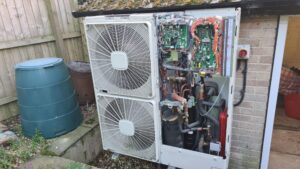
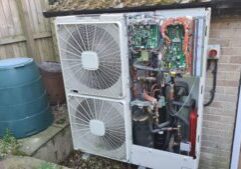
An air source heat pump does the same clever trick, moving heat from one place to another rather than burning fuel to make it, but it’s built to be your home’s proper heating system. In winter it draws warmth out of the outside air (yes, even when it’s cold out) to heat your radiators or underfloor system and your hot water. Reverse that process and many modern heat pumps will cool your home in summer as well.
The useful way to think about it: an air conditioner is a cooling gadget you add on top of your existing heating. An air source heat pump replaces your boiler and, as a handy bonus, many can cool too. There’s also a middle option worth knowing about, an “air-to-air” heat pump. It looks and works much like air conditioning, with neat indoor units and no radiators, but it’s designed to heat as well as cool. In plain terms, it’s air conditioning that pulls its weight all year round. Keep that one in mind, because it matters when we get to grants.
Can a heat pump replace air conditioning?
In most cases, yes. The majority of modern air source heat pumps come with a reversible, or “active cooling,” mode. Switch it on in July, and the system runs in reverse, taking heat out of your rooms and moving it outside, exactly what an air conditioner does. So rather than paying for a boiler replacement and a separate air-con system, you can often get both comfort jobs from one bit of kit.
There are a couple of caveats. Not every heat pump is set up for cooling out of the box, so it’s worth asking your installer to spec one that is if summer comfort matters to you. And cooling through radiators isn’t ideal; it works best with underfloor heating or fan coil units. We’ve written a full explainer on exactly how heat pump cooling works if you want the detail. For now, the headline is simple: a well-chosen heat pump can genuinely do the job an air conditioner does, and keep you warm for the other nine months of the year too.
Running costs compared
Here’s where it gets interesting, because the honest answer is “it depends what you’re comparing.”
For cooling alone, the two are broadly similar. Both are heat pumps under the bonnet, both are efficient at shifting heat, and, crucially, the UK cooling season is short. Even in a warm year you might run cooling for a few weeks. So the summer running cost of a standalone air-con unit and a heat pump in cooling mode won’t be wildly different, and neither will break the bank over a Yorkshire summer.
The bigger money story is heating. A standalone air conditioner does nothing for your winter bills; your gas boiler carries on as before. An air source heat pump, on the other hand, replaces that boiler. A good one delivers roughly three to four units of heat for every unit of electricity it uses, which makes it far more efficient than a gas boiler. Electricity costs more per unit than gas, so the saving isn’t automatic, but pair a heat pump with a specialist heat pump electricity tariff and the sums start to look a lot friendlier. Martin Lewis has covered the suppliers now offering heat pump tariffs, and we’ve summarised it over here. The takeaway: air conditioning only ever costs you money in summer, while a heat pump changes your year-round heating bill, for the better, if it’s set up well.
Grants: what actually qualifies
This is the part that trips people up, and it’s changed recently, so it’s worth getting right.
The main scheme is the Boiler Upgrade Scheme (BUS), run by Ofgem for homes in England and Wales. It’s there to help you swap a fossil-fuel heating system, like a gas or oil boiler, for a low-carbon one. As things stand, it offers £7,500 off an air-to-water air source heat pump (the standard type that runs your radiators and hot water), and £2,500 off an air-to-air heat pump, the type that works like air conditioning.
That second figure is the game-changer for anyone weighing up cooling. Until fairly recently, the answer to “can I get a grant for air conditioning?” was a flat no. Now, if you fit an air-to-air heat pump as your heating system, one that keeps you warm in winter and cool in summer, you may be able to claim £2,500 towards it. A cooling-only unit bolted on next to your existing gas boiler still won’t qualify, because the grant is for systems that actually replace your heating and can warm the whole home.
A few conditions to be aware of: your installer needs to be MCS-certified (they apply for the grant on your behalf and knock it straight off your quote), the property needs to be in England or Wales, and you generally can’t be replacing an existing low-carbon system. There’s also 0% VAT on heat pump installations until spring 2027. Grant rules and amounts do change, so it’s worth checking the current position on GOV.UK or see our own Boiler Upgrade Scheme guide for the latest. It’s also why big names like Octopus have started offering air-to-air installs: with a grant attached, they’ve become a much easier sell.
Which is better for a Leeds home?
Be honest with yourself about how you’ll actually use it, and the answer usually sorts itself out.
If your only worry is a handful of stifling nights each summer and your boiler is fairly new and working fine, a standalone air conditioning unit is the simpler, cheaper fix. It does one job well, it goes in quickly, and you’re not touching your heating. For plenty of homes around Roundhay, Alwoodley and Wetherby, that’s a perfectly sensible choice.
But if your boiler is getting on a bit, or you’re already thinking about your next heating system, the maths shifts. Our climate up here is heating-heavy, long, cool, damp winters and a short cooling season, so the technology that earns its keep for most of the year is the one that heats. An air source heat pump (or an air-to-air system) gives you efficient heating for the nine months that matter and cooling for the few weeks you’ll want it, often with a grant towards the cost. You’re solving two problems with one install rather than paying twice.
In short: cooling-only need with a healthy boiler points to air conditioning; a heating system due for replacement, plus a wish for summer comfort, points to a heat pump. There’s no single right answer, only the right answer for your home.
Frequently asked questions
The verdict
If you just need to take the sting out of a few hot nights and your heating is fine, a standalone air conditioner is the quick win. If your boiler is nearing the end of its life, an air source heat pump, or an air-to-air system with a grant behind it, gives you efficient heating and summer cooling in one go, which is usually the smarter long-term buy for a Leeds home.
Not sure which camp you’re in? That’s exactly the kind of thing we’re happy to talk through. Get in touch for a friendly, no-nonsense chat about your home, and we’ll help you weigh up the options. You can also read more about air source heat pump installation on our site.
Remember: Always confirm Gas Safe registration with any engineer. See Energy Safe Register for more info.
GET IN TOUCH on 0113 513 5130 or 07791 586 147
Safe Boiler Installations in Leeds from S Fearn Plumbing & Heating.
Give us a call
Explore your options and start benefiting from a modern, energy-efficient boiler today.