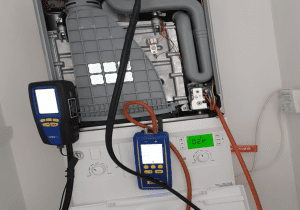
A boiler can look and sound normal while problems build up in the flue, the pipework or the working parts. A service gives a gas engineer the chance to find them before they cause a breakdown or a safety risk.
This article sets out seven common findings, starting with the most safety-critical. Each one explains what it can cause, how it is usually fixed and whether a homeowner can spot it. The list shows common findings, not a ranking of how often each one occurs.
What does a gas engineer find during a boiler service?
| Quick answer: A gas engineer commonly finds signs of poor combustion or flue faults, dirty or blocked parts such as the heat exchanger, and low or falling system pressure. Other common findings include condensate pipe problems, sludge, worn parts and settings that waste fuel. Problems caught early are usually simpler to fix. |
1. Signs of poor combustion, flue or ventilation faults
Poor combustion means a boiler is not burning gas fully, and it is the most safety-critical finding a service can uncover. The HSE explains that carbon monoxide is produced when fuel does not burn properly, and that poorly installed, maintained or ventilated appliances and flues are linked to carbon monoxide deaths. The usual fix depends on the cause, and a Gas Safe registered engineer must carry it out.
Homeowners can sometimes spot warning signs. The Gas Safe Register lists sooty staining around an appliance, a pilot light that keeps going out and extra condensation on windows. A carbon monoxide alarm is a useful second line of defence, but Gas Safe says never to rely on one alone.
2. A dirty or blocked heat exchanger
The heat exchanger passes heat from the burning gas to the water, and it can clog with limescale, sludge and debris. Vaillant says a Gas Safe registered engineer should check it every 12 months, because a build-up can cause noise and lower efficiency. If it is missed, the boiler may become noisier and work less well.
The usual fix is cleaning, a limescale reducer where scale is the cause, or replacement if the exchanger is cracked or leaking. A homeowner may hear whistling or tapping, but the part is a job for an engineer, and Vaillant says never to remove a heat exchanger yourself.
3. Low or falling system pressure, and small leaks
Low pressure usually means water has been lost from the sealed heating system. Which? lists recently bled radiators, a system left off for a long time and a leak as common causes. If the pressure keeps dropping, a leak is the likely suspect.
The usual fix is topping the system up to about one bar, and Worcester Bosch says a gauge in the red means a top-up is needed. A homeowner can notice this finding, since the pressure gauge is visible on the boiler. Which? advises calling an engineer if the pressure keeps falling.
4. A blocked or frozen condensate pipe
A condensing boiler drains its waste water through a trap and a condensate pipe, and either can stop the water flowing. Vaillant says sediment can build up in the trap, and that cleaning it is part of a regular service. For example, if the pipe freezes in prolonged cold weather, the boiler may stop working.
Homeowners can often notice a frozen pipe with gurgling noises or a boiler that stops in freezing weather, according to Worcester Bosch. Pouring warm, not boiling, water along the pipe usually thaws it, and insulating the outside section helps prevent a repeat.
5. Sludge or magnetite in the heating system
Sludge, also called magnetite, is a black deposit of rusted metal that forms in radiators and pipes. Baxi says it can result in blocked pipes, inefficient radiators and damaged boiler parts, and that repairs caused by it are not covered by its warranties.
The usual fix is a system clean, a magnetic filter that catches particles, and a check of the inhibitor level at each service. A homeowner may notice radiators that are hot at the top and cold at the bottom, or a noisy system with gurgling and kettling.
6. Worn or failing components
Seals, pumps, valves and thermostats wear out over time, and a service is a chance to spot them early. Which? says a service should catch minor faults early, which can prevent much larger repair bills. For example, the diverter valve directs hot water either to the radiators or to the taps, so a faulty one may stop the boiler switching between the two.
The usual fix is for an engineer to replace the part. Homeowners seldom see wear directly, though a leaking pump, which Baxi lists as a sign of sludge, can be visible.
7. Reduced efficiency from settings, scale or poor maintenance
A boiler can run for years while wasting fuel, because it still heats the house. The Energy Saving Trust cites Nesta research showing that lowering the flow temperature to 60°C improves efficiency by nearly 4%, and limescale can reduce efficiency too.
The usual fix is an engineer adjusting settings or descaling. Homeowners may notice rising bills, which Worcester Bosch lists as a possible sign of inefficiency, and Which? suggests asking the engineer about flow temperature during the visit.
Summary: the seven common findings
| Finding | What it can cause | Usual fix |
| Poor combustion or flue fault | Carbon monoxide risk | Engineer traces and corrects the cause |
| Dirty heat exchanger | Noise, lower efficiency | Cleaning, descaling or replacement |
| Low pressure or small leak | Less efficient heating | Top up to about 1 bar, trace any leak |
| Condensate pipe problem | Boiler shutdown | Clean trap, thaw and insulate pipe |
| Sludge or magnetite | Blocked pipes, damaged parts | System clean, filter, inhibitor |
| Worn components | Breakdowns, higher repair bills | Replace the part |
| Wasted efficiency | Higher fuel bills | Adjust settings, descale |
What happens if a boiler is never serviced?
A boiler that is never serviced can carry any of the seven findings unnoticed. Nothing about a missed service guarantees a fault, but it removes the yearly chance to catch one early.
The guarantee is also at stake. Worcester Bosch says yearly servicing is a condition of its manufacturer guarantee, and Which? says skipping annual servicing will in most cases invalidate a boiler’s warranty. If a boiler has already stopped working, our guide on what to do if your heating breaks down covers the first steps.
Is an older boiler worth servicing?
Yes, because a service shows how safe an older boiler is and what condition it is in. Worcester Bosch says a well-made boiler serviced each year professionally should last 10 to 15 years, and that some run beyond 20 years with a risk of high repair costs and unreliable performance.
A fair rule of thumb is to weigh a replacement when repairs become frequent, parts are hard to find, or bills climb, particularly past 15 years. Worcester Bosch lists those as warning signs. For the options, see our page on boiler replacement.
What can you safely check yourself?
Homeowners can safely check four things without opening the boiler. Read the pressure gauge, look for visible drips or leaks, feel for radiators that are cold at the bottom, and test the carbon monoxide alarm using its test button. Our guide to common boiler faults goes into more detail.
Anything beyond that is gas work, and gas work must be done by a Gas Safe registered engineer.
If carbon monoxide is suspected, the Gas Safe Register says to turn off the appliance if it is safe to do so, open doors and windows, leave the property and call the Gas Emergency Helpline on 0800 111 999.
Boiler servicing FAQs
How often should a boiler be serviced?
Once a year. The Gas Safe Register advises having gas appliances safety checked annually by a Gas Safe registered engineer, and Worcester Bosch says an annual service is a condition of its guarantee.
Can I service my boiler myself?
No. Work on a gas boiler must be done by a Gas Safe registered engineer, and Which? warns that removing the casing yourself is dangerous and can void any remaining warranty. Homeowners can carry out the simple checks listed above.
What happens during a boiler service?
The engineer inspects the boiler and flue, runs the boiler to check it works properly, cleans parts where needed and explains what they found. Which? says to expect a written service report. The exact checks vary with the type of boiler.
Next step
A yearly service is how a gas engineer finds these seven things early. If it has been more than twelve months since the last one, S Fearn Plumbing & Heating covers Leeds and nearby areas, and you can book a boiler service for prices and availability.
Give us a call
Explore your options and start benefiting from a modern, energy-efficient boiler today.