It’s one of the first questions we get asked, and a fair one: will a heat pump annoy me, wind up my neighbours, or ruin evenings in the garden? Plenty of sites will tell you “heat pumps are quiet” and leave it there. Here’s the actual number: published figures for the units we install most sit in the mid-40s to low-50s dB(A), below normal conversation, and there’s now a legal limit of 37 dB(A) at your neighbour’s window that any UK installation has to meet. Below, we’ll break down where those figures come from, what they mean in everyday terms, and what genuinely affects the noise you’ll hear day to day, so you can judge for yourself rather than take our word for it. If you want the fuller picture first, our beginner’s guide to air source heat pumps is a good place to start.
First things first: is anyone at risk?
Before any troubleshooting, rule out the two genuine emergencies below. If either applies, act on it before anything else in this guide.
| If you can smell gas: don’t touch any electrical switches, put out any naked flames, open doors and windows, get everyone out of the house, and call the National Gas Emergency Service on 0800 111 999. It’s free and open 24 hours a day.
If your carbon monoxide alarm is sounding: get everyone out into fresh air straight away, and call 999 if anyone feels unwell, has a headache, dizziness or nausea. Don’t go back inside until it’s been made safe.
One thing to know: the emergency line will make the situation safe, but it won’t repair your appliance. That part comes afterwards, once everyone’s safe. |
Gas boiler stopped working: quick checks.
If there’s no gas smell and everyone’s safe, here are the quick things worth checking before you call anyone. Most take a minute.
- Power. Make sure the boiler is switched on, the plug or fused spur hasn’t tripped, and nothing has flipped at your fuse box.
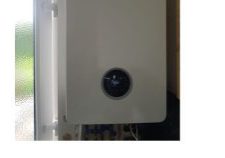
- Pressure. Find the pressure gauge on the front of the boiler. If the needle is below about 1 bar (often in a red zone), low pressure can stop it working. Topping it up via the filling loop is usually simple; your boiler manual shows how.
- Thermostat and timer. Obvious, but easily missed: check the thermostat is turned up and calling for heat, the timer or programmer is set correctly, and the batteries in a wireless thermostat aren’t flat. Cold snaps and clock changes catch people out every year.
- Error codes. Note any code or flashing light on the display; it’s the boiler telling you what’s wrong, and it’ll help whoever fixes it.
For a fuller breakdown of what specific fault codes mean and how to fix the most common gas boiler issues, see our guide to diagnosing common boiler faults at home. Here, we’ll keep moving.
One very common winter culprit: a frozen condensate pipe
If your boiler was running fine and suddenly cut out during a cold snap, a frozen condensate pipe is one of the most likely causes, and one of the most fixable. The condensate pipe is the plastic pipe that carries wastewater from your boiler outside to a drain. In freezing weather, the water inside can turn to ice and block it, and the boiler shuts down as a safety measure.
Signs to look for: a gurgling or bubbling noise from the boiler, the boiler locking out, and often an error code relating to the condensate (for example, EA on many Worcester Bosch models, or F28/F29 on Vaillant; check your manual to be sure).
If the frozen section is the external pipe and you can reach it safely from ground level, you can usually thaw it yourself: pour warm, never boiling, water slowly along the length of the pipe. Manufacturers including Worcester Bosch and Vaillant, along with the industry’s Heating and Hotwater Industry Council, all warn against boiling water because it can crack the plastic. A hot water bottle held against the pipe helps too, and it may take a few goes. Once the water’s flowing again, reset the boiler.
Call an engineer if the frozen section isn’t safely reachable (never balance on a ladder in icy conditions), if thawing doesn’t bring the boiler back, or if it keeps happening. A pipe that freezes every winter usually needs insulating or re-routing properly.
Heat pump stopped working or seems less effective in the cold
Air source heat pumps work differently from gas boilers, and that trips a lot of people up in winter. Before you assume the worst, it’s worth knowing what’s normal.
This is usually normal, not a breakdown:
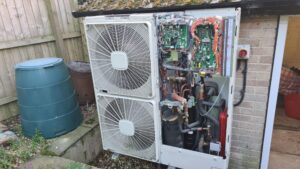
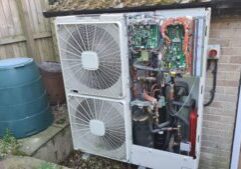
- Defrost cycles. In cold, damp weather, a heat pump periodically melts frost off its outdoor unit. For a few minutes, it may pause heating, sound a little different, or give off what looks like steam. That’s the system doing exactly what it’s designed to do, and it clears on its own.
- Slightly softer output on the coldest days. Heat pumps work harder when it’s very cold outside, so heating can feel a touch less punchy in extreme weather. A well-designed system still keeps you comfortable; it just runs for longer to do it.
These signs do suggest something’s wrong:
- No heat or hot water at all.
- Ice building up on the unit that doesn’t clear after a defrost cycle.
- Unusual or loud noises beyond the brief whirr of a defrost.
- Error or warning lights on the unit or its controller.
A couple of quick checks first: make sure the power or isolator switch is on, clear any leaves, snow or debris from around the outdoor unit, and check the thermostat is set correctly. Beyond that, a heat pump that’s genuinely faulted or producing no heat is an engineer’s job; it isn’t a DIY fix.
If you don’t currently have breakdown cover for your heat pump, winter is when it matters most. We’ve looked at home emergency and breakdown cover options for heat pumps separately, worth sorting before the next cold snap rather than during one. And if your heat pump is getting on in years and faults are becoming a pattern, it may be worth weighing up repair against a new installation, though that’s a calm-weather conversation, not an emergency one.
Frozen or burst pipes elsewhere in the house
It isn’t only your boiler’s pipework that freezes. Any exposed pipe, in a loft, garage, or running along an outside wall, can freeze when the temperature drops.
Spotting a frozen pipe before it bursts: little or no water from a tap, or a gurgling sound or odd smell from a tap or drain. Catch it at this stage, and you can often avoid the far bigger problem of a burst.
What’s safe to try: gently warm the frozen section with a hot water bottle, warm towels or a hairdryer on a low setting, working from the tap end backwards. Keep your heating on low to help it thaw and stop it refreezing, and open cupboard doors (under the sink, for instance) to let warm air reach the pipes. Never use a naked flame or blowtorch, and don’t force anything.
If a pipe has already burst: turn off your water at the stopcock straight away, usually under the kitchen sink or where the mains enters your home, then switch off the electrics at the fuse box if water is anywhere near them. Catch what you can in buckets, and call a plumber. A burst pipe isn’t a job to tackle solo.
When to call an engineer vs. when it can wait
Not every breakdown is a 2 am emergency. A quick rule of thumb:
- Call for help now if there’s no heat and it’s below freezing overnight, especially with young children, elderly or unwell people in the house, if a pipe has burst, or if you have any safety concern at all.
- Same day, but not the middle of the night, if the house is cooler than usual but not dangerously cold, your hot water still works, and there are no safety worries. Book the next available call-out.
- It can usually wait a day or two if it’s a minor niggle, one lukewarm radiator, say, with everything else working fine. Worth getting looked at, but not an emergency.
If in doubt, a quick phone call costs nothing. Our Leeds boiler repair team can talk you through whether it needs attention right away or can hold until morning.
Preventing it happening again
Once you’re warm again, a little prevention goes a long way:
- Book an annual service. Most winter breakdowns trace back to small issues a yearly check would have caught. Here’s our boiler servicing if you’re due one.
- Insulate exposed pipework. Cheap foam lagging on external condensate and water pipes dramatically cuts the risk of a freeze, one of the best-value winter jobs there is.
- Heat pump owners: get breakdown cover in place before winter, and keep the outdoor unit clear of debris.
- Leave the heating on low during very cold spells rather than off; it keeps pipes above freezing for pennies.
Cold house? Let’s get it sorted.
A heating breakdown in the depths of winter is stressful, but it’s rarely as bad as it feels in the moment, and you don’t have to sort it alone. If you’re in Leeds or the surrounding areas and your heating has stopped, don’t sit and shiver: call S Fearn Plumbing & Heating on 07791 586 147 for emergency boiler repair. We’re a local, Gas Safe-registered team. Our vans carry common parts so we can often fix things on the first visit, and there’s no call-out charge when we carry out the repair. Let’s get your home warm again.
Give us a call
Explore your options and start benefiting from a modern, energy-efficient boiler today.